BITSoM-EFMD survey: 73% of B-school leaders expect AI to reshape management education
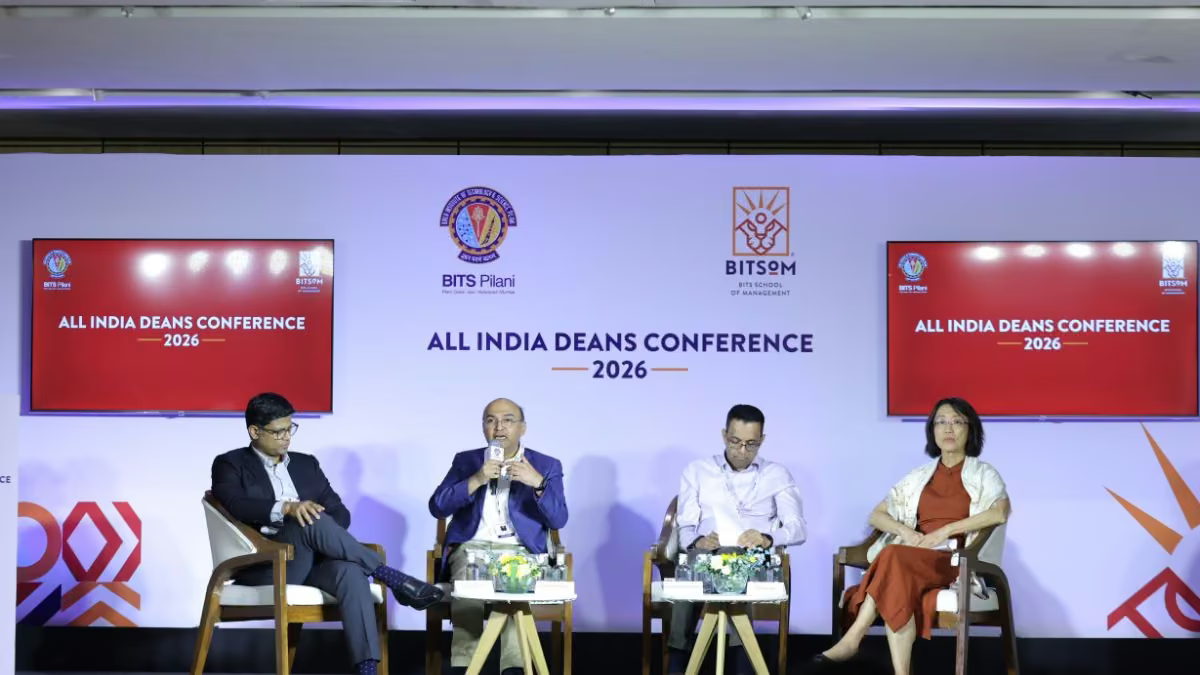
According to 73% of Indian B-school leaders surveyed by BITS School of Management (BITSoM) and the European Foundation for Management Development (EFMD), artificial intelligence (AI) will significantly or fundamentally transform management education. However institutional responses continue to be inconsistent, with some business schools still in the observation or early experimentation stages.
The findings were unveiled at the inaugural All-India Deans Conference organised by BITSoM in Mumbai, which brought together several academic leaders from India and around the world to discuss the future of business education. Adoption of AI, critical thinking, management research, and international cooperation were the subject areas of the two-day conference.
22 deans and academic leaders of Indian business schools gave their suggestions for the EFMD x BITSoM Global Perspectives Survey Report. Key concerns highlighted were rising employer expectations and demand for traditional MBA degrees, coupled with questions about AI governance and curriculum redesign.
Also read | BITS Pilani receives USD 1 million to set up CoE for advanced materials research
AI adoption challenges
Almost 38% of those expecting fundamental disruption are still in the watch-and-wait or early experimentation mode. Governance, privacy and responsible AI use were the biggest challenges identified by 41% of respondents, followed by curriculum and assessment redesign (36%) and faculty capability development (32%). 59% respondents identified shifting graduate roles and company expectations, while 54% mentioned shifting market demand for standard MBA degrees.
Vishal Gaur, dean of Cornell SC Johnson Graduate School of Management, said: “AI is going to be the next growth engine for MBA career paths. Integrating AI into business education is an opportunity to elevate how we cultivate human reasoning. Our goal is to ensure that as computational tools become ubiquitous, our students double down on critical analysis, ethical decision-making, and original thought rather than surrendering strategic judgment to automated systems.”
The conference also discussed the need to shift from traditional lectures to project-based learning, industry problem-solving and interdisciplinary collaboration, but without losing independent critical thinking.
Also read | UPESSC conducts Principal recruitment test in Lucknow with AI-enabled monitoring; 88.81% appear
Research and partnerships
Another priority was international collaboration, with 91% of respondents supporting broad partnerships with joint research, faculty exchanges and industry initiatives, versus 9% who preferred standalone student mobility programs. Institutional reputation was a factor in partner selection for 85%, and faculty quality was important for 80%.
Kieran Fernandes, executive dean of Durham University Business School, said: “Excellence in research and teaching should reinforce each other. High-impact research must inform pedagogy, bringing cutting-edge insights into the classroom. Global multi-dimensional partnerships between institutions will be vital in co-creating knowledge that elevates both academic rigor and real-world learning”.
The conference also urged that management research based on Indian experiences, including the country’s digital public infrastructure, demographic shifts and changing business models, should contribute to global knowledge.
Saravanan Kesavan, dean of BITSoM, said, “At BITSoM, we see this initiative as the beginning of a sustained conversation-one that will help shape a more relevant, collaborative, and future-focused approach to management education.”