Delhi private schools move Supreme Court against new fee rules; oppose parent-led approval panels
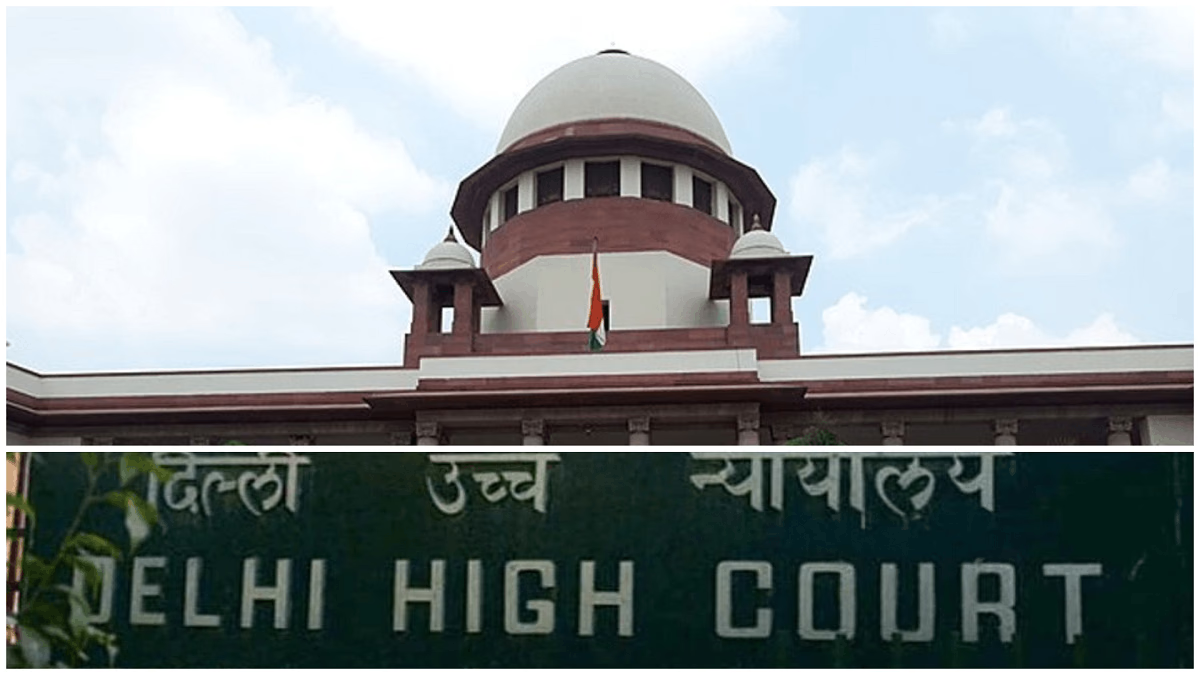
Private unaided schools in Delhi, comprising around 900 institutions, have approached the Supreme Court challenging the Delhi High Court’s refusal to stay a government order directing the constitution of school-level panels to regulate fees.
A Special Leave Petition (SLP) has been filed by the Action Committee of Unaided Recognised Private Schools against an interim order dated January 8 passed by a division bench of the Delhi High Court, which refused to grant relief against implementation of the Delhi School Education (Transparency in Fixation and Regulation of Fees) Act, 2025.
Earlier in December, the Delhi government officially notified the Delhi school fee fixation rules for private unaided schools. The new regulation mandated setting up of a school-level fee regulation committee (SLFRC), which will include five parents, three teachers, and one government observer.
Following this, the association of more than 800 private unaided recognised schools filed a petition challenging the new rules which allow private schools to charge fees fixed by the Delhi government.
However, the high court dismissed the petition and extended the timeline for constituting committees and for submission of proposed fees by school managements.
Delhi School Fee: What changes under new rules
In the SLP, the petitioners contended that the Delhi HC failed to grant interim protection despite what they described as “irreconcilable conflict” between the Delhi government’s 2025 fee regulation law and the existing Delhi School Education Act and Rules, 1973, which they argued already governed the private schools in the national capital.
The schools also challenged the December 24 order of DoE, which allegedly seeks to enforce the new rules for an academic year that is already nearing completion.
According to the central legislation, the private schools are allowed to collect fees as fixed by the school management, which comprises 21 members, with 2 parents and one teacher, apart from four nominees of DoE.
“Whereas the State Legislation seeks to undermine and render meaningless the fee fixed by the SMC under the Central Act and makes the said fee subject to an approval of a Committee comprising of 5 parents, 3 teachers, 1 Principal and 1 member of the Management (SLFRC), which has to decide the matter unanimously as opposed to democratically,” they said.
Schools oppose unanimous approvals
While the existing order does not require private schools to get prior permission before fixing or increasing the fees at the start of the academic year, the new rules insist on not only a prior approval before increasing the fees, but also seeks to vest that power to grant approval in a body comprising majorly, of the parents and teachers, it said.
Schools are required to constitute “parent-dominated committees” and submit fee proposals, failing which punitive action may be taken against schools.
The SLP sought a stay order on the implementation of 2025 Act “on the grounds of being wholly unconstitutional, without jurisdiction, repugnant to the Central Legislation, violative of Articles 239AA and 254 of the Constitution of India, apart from being violative of the fundamental rights of Private Unaided Schools.”