ICAR DDG says NEP 2020, skills and career options for agriculture students priority
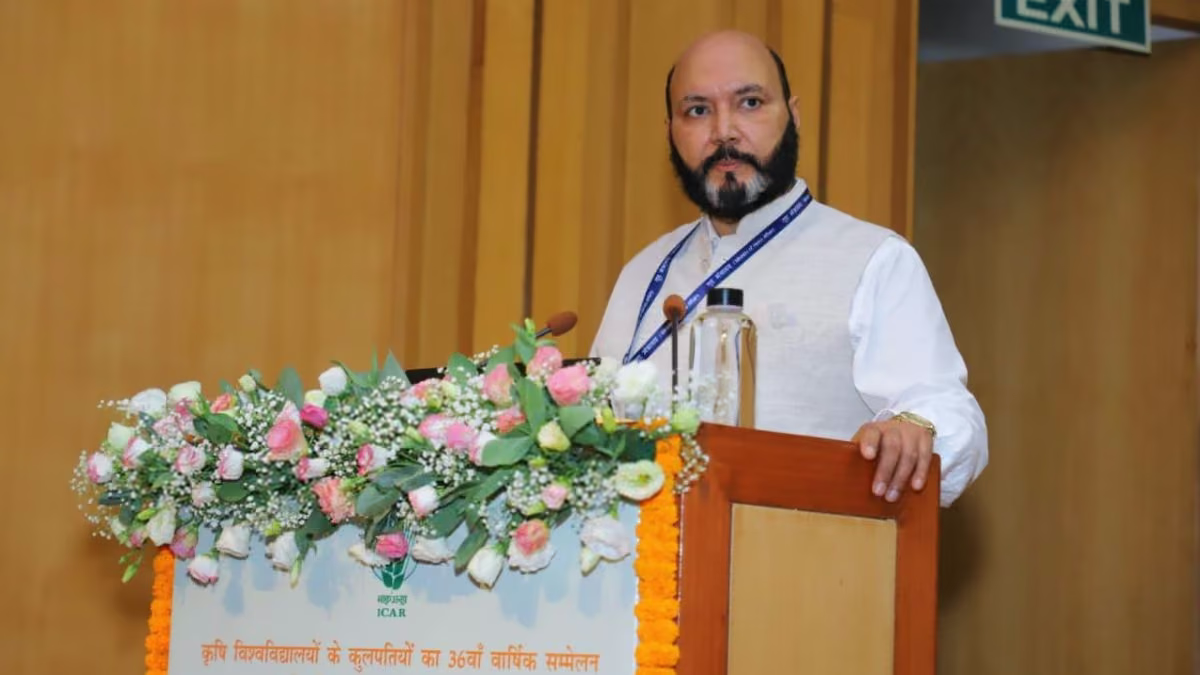
Yashpal Singh Malik, who recently took charge as deputy director general (Agricultural Education) at the Indian Council of Agricultural Research (ICAR), spoke to Musab Qazi of Careers360 about the future of agriculture education and the implementation of the National Education Policy (NEP) 2020. He also shared his thoughts on ways to make agriculture graduates more employable.
In his interaction with Musab, Malik stressed that implementing the National Education Policy (NEP) 2020 will remain one of the key priorities for agricultural education; however, the implementation has taken some time. He said the policy can offer students flexibility through multiple entry and exit options, opportunities to pursue specialised studies and the possibility of taking up two degrees.
Malik, a veterinarian and virologist, has previously worked at Indian Veterinary Research Institute (IVRI), Izatnagar, and also served as the dean of the College of Animal Biotechnology at Guru Angad Dev Veterinary and Animal Sciences University, Ludhiana. His research work includes coronaviruses, Japanese encephalitis virus and rotavirus.
NEP offers flexible learning, practical skills
The multiple entry-exit system might also help students who discontinue BSc agriculture or diploma courses because of personal or financial reasons. Students will receive a certificate, diploma or degree depending on how much of the course they could complete before discontinuation.
Candidates who exit will also get the option to return to education later if their circumstances are positive, Malik pointed out. Agricultural colleges are also introducing more practical training. Students are being introduced to areas such as farm mechanisation, automation and drone technology, along with industry-oriented skills.
Opportunities beyond government jobs
Malik said the employment picture for agriculture graduates should not be viewed only through placement figures. Agricultural universities have placement cells along with industry partnerships to connect students with employers. At the same time, some graduates are also going for entrepreneurship, higher education and careers in allied areas.
Emphasising that the private sector is yet to become attractive to graduates, Malik said, “If someone's industry-ready, they are ready to take them even at a higher post. We have 114 institutes including ICAR, 80 universities, around 5,000 scientists and semi-technical posts that are open to graduates and postgraduate students. So, there's enough capacity to absorb graduates.”
He pointed to agriculture startups working in areas such as farm equipment and disease detection, with some reportedly earning Rs 20-30 lakh annually. Others are pursuing opportunities abroad or moving into sectors such as fisheries, veterinary sciences and management.
ICAR on quality, admissions, new agriculture programmes
ICAR also takes into account the quality of agricultural institutions through committees that review faculty strength, infrastructure, salaries, and student feedback. Malik said accreditation requirements are also encouraging institutions to improve their faculty strength and academic standards.
Meanwhile, the National Testing Agency (NTA) continues to hold agricultural entrance examinations. According to Musab, Malik said the number and geographical diversity of candidates have increased, with students from different states and even other countries taking admission into agricultural universities.
Malik also shared that agriculture graduates are recently exploring different career paths, from startups and short-term courses to MBA and jobs in allied sectors. The options can also extend to fields like fisheries, veterinary sciences, and the armed forces.