Govt school to Glasgow: NIT Agartala civil engineer wins Marie Curie Postdoctoral Fellowship
3 mins read
|By Pritha Roy Choudhury
Now at IIT Bombay on the National Postdoctoral Fellowship, Pranoy Debnath previously studied in NIT Agartala, IIT ISM Dhanbad. His MSCA project is at University of Glasgow
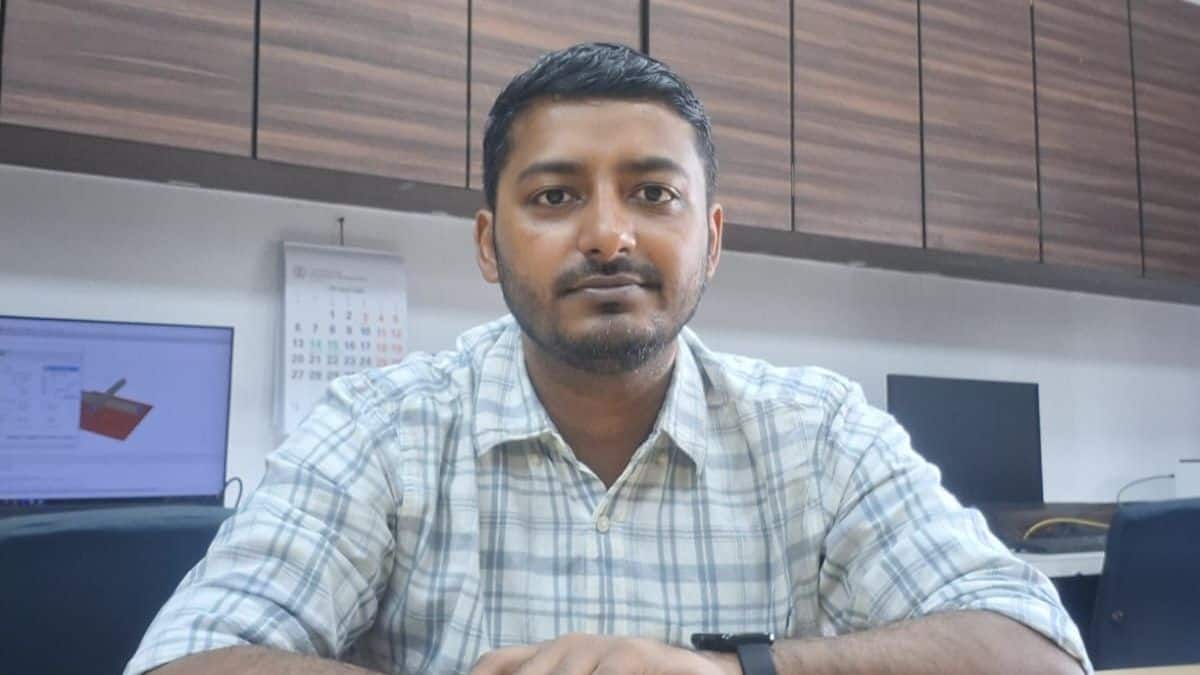
Pranoy Debnath is currently at IIT Bombay on the National Post-Doctoral Fellowship. His research on the Marie Curie Fellowship will be with a project at University of Glasgow (Image: By special arrangement)
Pranoy Debnath works in stabilising structures against hazards. As a PhD scholar at Indian Institute of Technology - Indian School of Mines (IIT ISM) Dhanbad and later, postdoctoral researcher at IIT Bombay, his research focused on strengthening buildings in earthquake-prone areas. From late 2026, he will work on building foundations for wind-turbines at the University of Glasgow, Scotland, on the Marie Skłodowska-Curie Actions (MSCA) Postdoctoral Fellowship.
Debnath comes from Tripura. The state and its neighbours in northeast India are all in seismic zone V, where probability of a major earthquake is very high. “Over the years, my work focused on making structures safer and stronger against natural hazards by combining engineering principles with advanced simulation tools and modern data-driven methods,” said Debnath, 33.
Get our Daily Newsletter to stay updated on education policies, research, jobs & more.
Even while pursuing a B.Tech in civil engineering at National Institute of Technology (NIT) Agartala, Tripura, he bore a deep interest in computers and learnt programming languages along with his course work. These skills later became crucial in advanced modelling, simulation, and research.
In Glasgow, Debnath will work on rock-based foundation systems for on-shore wind turbines. He’s the second scientist from Tripura to win the fellowship. The first, Chaidul Haque Chaudhuri, who was awarded the fellowship in 2023, is currently an assistant professor at IIT Bhubaneswar.
Government school, NIT Agartala
Debnath’s journey has been startling. He attended a government school in Agartala where his father was a clerk in the state’s higher education department.
When his professional education put a strain on the family’s finances, he started privately tutoring school students to support himself. “Balancing studies with teaching helped me build the discipline, time management skills which later helped me a lot,” he said.
After graduating, the newly-minted civil engineer joined a private firm where he worked on metro and micro-tunnelling projects in Kolkata. This was the first time he was living away from home and independently. However, two years later, he returned to NIT Agartala, this time to pursue an MTech in structural engineering.
PhD at IIT (ISM) Dhanbad
By the time he wrapped up MTech, Debnath was no longer seeking a career in industry. “I wanted to solve engineering problems that affected vulnerable communities, especially in hazard-prone regions,” he said.
He studied how buildings behave during earthquakes and developed methods to strengthen them. His research at IIT ISM Dhanbad was particularly relevant to the northeastern states of Tripura, Assam, Meghalaya, Sikkim, and other high seismic-risk areas where many traditional masonry and vernacular structures remain vulnerable.
His programming background became a major advantage during this phase.
“Research life, however, came with repeated failures, long hours, and constant revisions,” he said. Despite the challenges, he completed his PhD in just three-and-a-half years and published multiple research papers.
IIT Bombay: Structural engineering
After his PhD, Debnath was selected for the prestigious National Postdoctoral Fellowship (NPDF) at IIT Bombay. He is currently working there on “soil–structure interaction”, an advanced area of structural engineering.
By using machine learning models, he aims to “simulate multiple soil and structural conditions, bringing modern computational intelligence into civil engineering research”, he said. This is what earned him the Marie Curie Fellowship, he believes.
After completing his postdoctoral fellowship in Scotland, Debnath hopes to join an IIT.
NEWSLETTER
Academia360 Daily
Get key education news, research, and job opportunities in your inbox.
I agree to Academia360’s Privacy Policy and Terms & Conditions and provide consent to be contacted for promotion via mail, sms, whatsapp, etc.
We’d love to hear from you! Write to us at feedback@academia360.in with your suggestions or thoughts.

 Job Opportunities