IIT Delhi, AIIMS, IHBAS roll out first Hindi music-based speech therapy for stroke patients
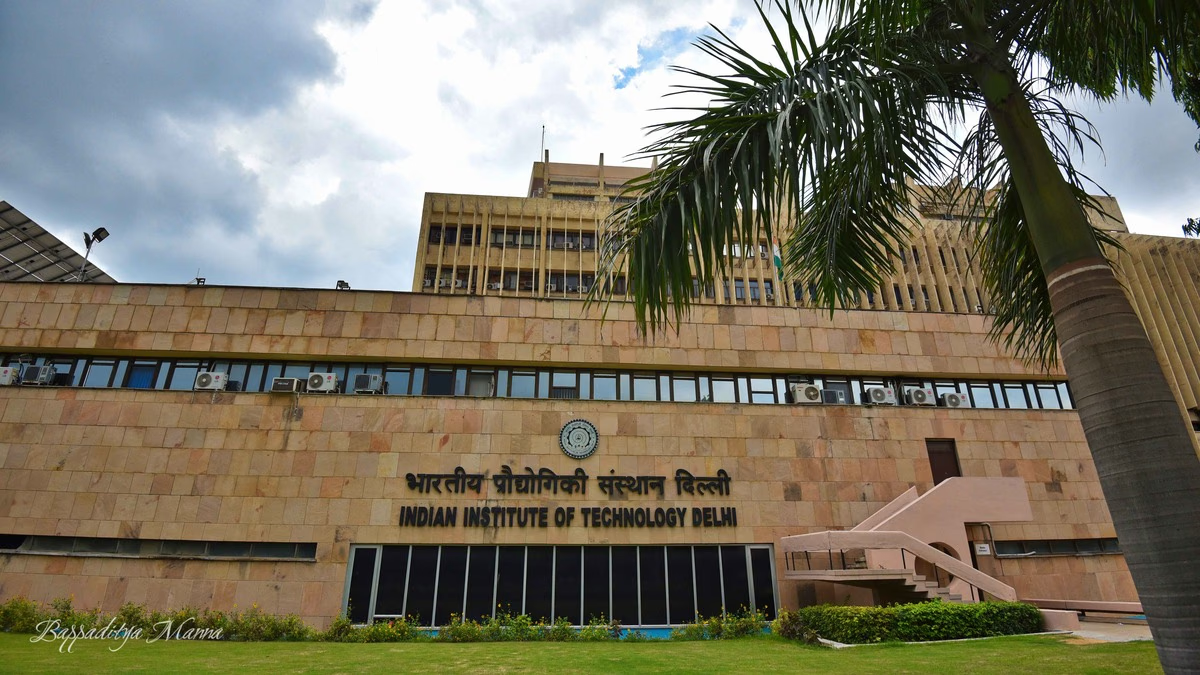
Researchers from Indian Institute of Technology (IIT) Delhi, All India Institute of Medical Sciences (AIIMS) New Delhi and the Institute of Human Behaviour and Allied Sciences (IHBAS) have developed the first Hindi version of Melodic Intonation Therapy (MIT), a music-based speech therapy designed to help stroke survivors with aphasia regain their ability to speak.
The findings from the pilot study have been published in the international journal Aphasiology. While Melodic Intonation Therapy has been widely used in English and other Western languages, no validated Hindi version existed until now.
The researchers adapted the therapy specifically for Hindi by redesigning its melodies and rhythmic patterns to match the language's natural cadence rather than simply translating the English exercises.
Pilot study shows encouraging results
Researchers from IIT Delhi, AIIMS New Delhi, and IHBAS collaborated on the study, bringing together expertise in engineering, neurology, otorhinolaryngology (ENT), and speech therapy to develop the first Hindi version of MIT for stroke survivors with aphasia.
According to the official statement released by IIT Delhi, as part of the study, six Hindi-speaking stroke survivors underwent 40 therapy sessions, each lasting 45 to 60 minutes, under the supervision of a trained speech therapist. All participants completed the programme and demonstrated clinically meaningful improvements. The research team emphasised that the results are preliminary due to the small sample size.
Researchers behind the breakthrough
The project was led by IIT Delhi's N M Anoop Krishnan and Rahul Garg, in collaboration with Deepti Vibha of AIIMS New Delhi. Rahul Garg, one of the researchers who led the study, said, “Patients were able to string together longer sentences, spoke more freely, and reported gains in their quality of life. There were no adverse effects”.
N M Anoop Krishnan, another IIT Delhi researcher who also led the study, highlighted, “With only six patients, the results should be seen as a strong preliminary signal rather than final proof. The team is also exploring digital tools so that the therapy can eventually reach patients well beyond specialist hospitals”.
Further research involving larger patient groups will be needed to confirm the therapy’s effectiveness and explore its potential for wider clinical use.