IIT Guwahati researchers develop affordable technology to remove arsenic and fluoride from groundwater
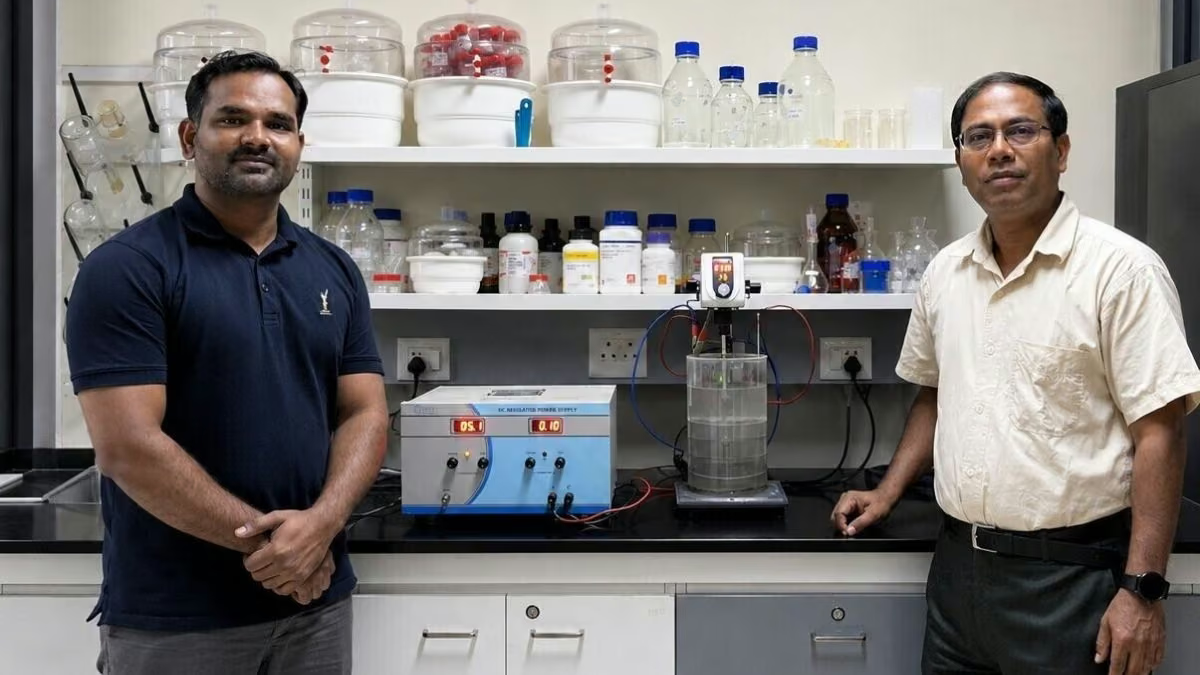
The Indian Institute of Technology Guwahati (IIT Guwahati) researchers have developed a new water-treatment system that can remove both arsenic and fluoride from contaminated groundwater. The technology will offer an easy and affordable option for industries working with groundwater pollution.
The press release stated, “The researchers from IIT Guwahati developed a rotating-anode electrocoagulation (RA-EC) reactor that achieved up to 98.2% arsenate and 91.8% fluoride removal within minutes.” For treating 1,000 litres of water, depending on the level of contamination, the estimated cost of operating the system was between Rs 18 and Rs 58.
Highlighting the need for such research, Mihir Kumar Purkait, Department of Chemical Engineering, IIT Guwahati, said, “Groundwater serves as the primary source of drinking water for millions of people across India. In several regions, however, it contains both arsenic and fluoride, two contaminants that pose significant long-term health risks.
Purkait added that researchers have noted that treating arsenic and fluoride together can become challenging because the two contaminants respond differently to known purification methods.
IIT Guwahati plans pilot-scale testing
The researchers have also seen the scope for using the reactor alongside existing treatment methods such as adsorption and membrane filtration. This will allow various treatment approaches which can be combined depending on the water quality being treated.
The findings were published in the Chemical Engineering Journal. The study was co-authored by Mihir K Purkait and Mukesh Bharti of IIT Guwahati. The research will develop a pilot-scale continuous-flow version of the reactor. The team will also explore automated controls using sensors that can track pH, conductivity, electrical current and rotational speed during treatment, the press release said.
Further, Mukesh Bharti, Research Scholar, Department of Chemical Engineering, IIT Guwahati, added, “We systematically evaluated how operating conditions, including rotational speed, current density, electrode spacing, and treatment time, influence performance. Our technology was also tested under realistic groundwater chemistry, including the presence of naturally occurring ions such as calcium, magnesium, bicarbonate, sulphate, and phosphate, as well as real groundwater samples collected from Assam.”