IRIS 2026: Academic, industry experts address research impact, PhD ecosystem, ranking parameters
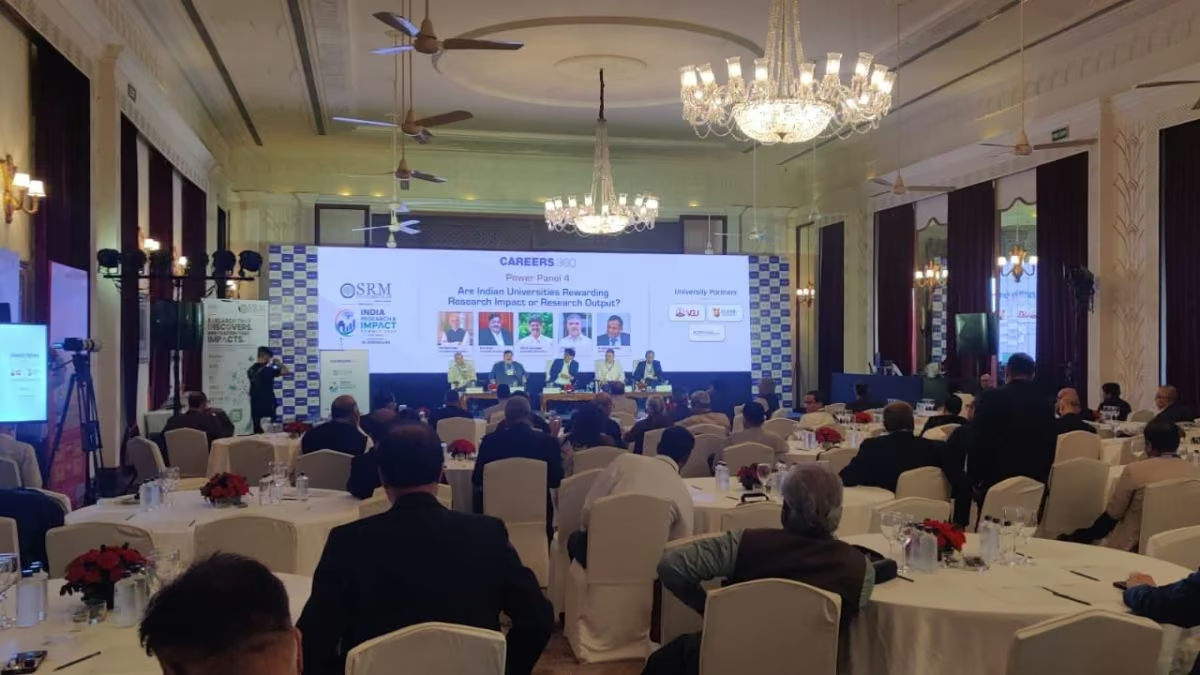
At the Careers360 India Research & Impact Summit (IRIS) 2026, various academic leaders and industry representatives discussed key questions shaping India’s research ecosystem across three panel discussions. The sessions examined whether Indian universities are rewarding research impact or research output, how PhD students and research fellows view the country’s research environment, and whether existing research parameters used in ranking and listing frameworks fairly assess the quality and impact of research.
The discussions brought together senior academics, university leaders, industry representatives and research professionals to explore the challenges and opportunities facing India’s research landscape.
Are Indian Universities Rewarding Research Impact or Research Output?
The panel, “Are Indian Universities Rewarding Research Impact or Research Output?”, brought together Rudra Pratap, Vice-Chancellor, Plaksha University; B Suresh, Pro-Chancellor, JSS University, Noida; Ch. Satish Kumar, Vice-Chancellor, SRM University AP; Onkar Bagaria, CEO, VGU Jaipur; and Suresh Ramanatham, CEO, International Management Institute (IMI). The discussion explored how Indian universities evaluate and reward research, and whether current academic incentives place greater emphasis on research output or its wider academic, industry and societal impact.
Addressing the topic of discussion, Satish Kumar said that an associate in San Francisco studied in India and found that most central universities were following an output-based reward system, whereas a few IITs follow a mixed method. He said, “Impact in the field of technology is easy; it may take shorter than five years. If you take social research, it may take decades”. NIRF rankings cannot be entirely wrong; instead, for research, a separate kind of grading system should be developed based on societal impact.
Suresh Ramanatham, CEO, IMI, said, “Complete perversion of the research environment not just in India but across other parts of the world.” Indians are obsessed with numbers, so we objectify things that cannot be done.
The panellists concluded by saying that India is on its journey of research; one size does not fit all. India must define its own research, vision, mission, and align the faculty by defining what the metric is for the institution and continue this for India to excel in research and not just in terms of volume.
Fresh Blood: How PhD students and research fellows see India’s research environment
The panel, “How PhD Students and Research Fellows See India’s Research Environment”, brought together Sandeep Kumar Shukla, Director, IIIT Hyderabad; Sandeep Sancheti, Vice-President, Academic Relations, Elsevier; Sujatha Kshirsagar, President and Chief Business Officer, Career Launcher; Dhruv Galgotia, CEO, Galgotias University; and Asit K Barma, Director, BIM Trichy. Outside the IITs, the state university PhD students are worried about the stipend.
Asit K Barma started the discussion by saying that first, research begins with the supervisors. More than the supervisor, the sole thing that comes to researchers' minds is how good the supervisor is, if he or she is demanding, if the recommendation works forward for prospects like getting a job”. There should be a course on how to review research projects for supervisors because the quality of research is important.
Others said that India is lagging when it comes to investing in research. So it is best if there is a transition; researchers can go overseas but should have work-embedded research created. Speaking about the mental health of researchers, the panellists said success has to be shared, and failure should be shared, so there should be teamwork so that there is no pressure.
Research and Rankings: How fair are research parameters in ranking and listing frameworks?
The panel, “Research and Rankings: How Fair Are Research Parameters in Ranking and Listing Frameworks?”, brought together Satya Narayanan R, Founder and Chairman, Career Launcher; Bipin Nair, Registrar, Amrita Vishwa Vidyapeetham; Achal Agrawal, Founder, India Research Watch (IRW); and Hemant Sahal, Founder and CEO, Digii. The discussion focused on how research is evaluated in ranking and listing frameworks, the relevance of existing parameters, and whether current metrics capture the quality and impact of research.
While speaking about measuring research outcomes of different institutions, Bipin Nair said that “It's impossible to bracket universities and a framework to evaluate universities.” Talking about artificial intelligence, speakers said that with AI coming it there may be better ways to look at an institution. AI can benefit as far as research is concerned since it can find information easily from a vast number of sources, which could otherwise have otehrhwise taken ages. The concern is what impact AI has on our student community and what applications can be developed.