NIRF rewards research volume over impact, say academicians at Careers360 IRIS 2026; urge overhaul
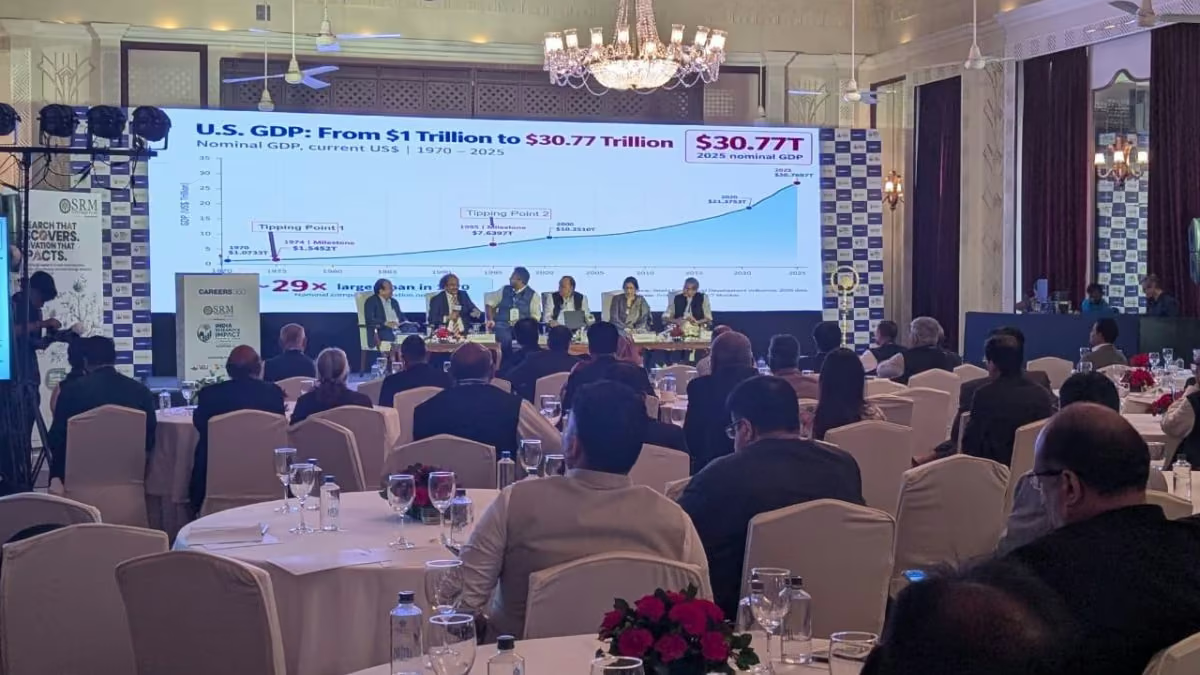
India is producing more research than ever, but much of it is counted than weighed. This was the message from vice-chancellors of top universities and eminent academicians at Careers360’s India Research and Impact Summit (IRIS) 2026, who argued that the National Institute Ranking Framework (NIRF) rewards publication volume over real-world impact, and in doing so could be encouraging questionable research practices.
The IRIS 2026, Careers360’s faculty awards event, brought together academics, university heads and industry leaders to brainstorm on the state of research in Indian higher education. The session’s central area of discussion was how research is measured.
Panellists said that despite a steady rise in India’s research output, structural issues in funding, faculty training and institutional incentives continue to hold back its global competitiveness. They called for closer collaboration among government agencies, universities and industry to build a sustainable research ecosystem.
NIRF Ranking: Volume over value
The scholars pointed out that the existing ranking systems lean heavily on quantitative volume measures such as the number of publications and do not really measure their social or economic impact. This focus, they said, has led to some unintended consequences, including an increase in problematic research practices that need to be addressed through direct policy intervention.
University leaders addressed the limitations of relying purely on publication metrics. The increase in research retractions is very much related to metrics-driven pressures, said V Ramgopal Rao, group vice-chancellor at BITS Pilani. He also added “...this quality, the retractions… it's all NIRF created. Only NIRF can solve it. Since they created this problem, they should solve it. All that is required is penalizing institutions for retractions”.
Rao also pointed to the strong international differences in high-quality academic production, citing that India published 28 papers in Nature and Science journals in 2025, compared to 501 by China and 1,412 by the US. India had only two papers as the corresponding author, while China had 300 and the US, more than 1,000.
Ananya Mukherjee, vice-chancellor, Shiv Nadar Institution of Eminence, also highlighted that quality work done by institutions and the diversity often go unrecognised as the traditional ranking frameworks do not take into account the qualitative achievements in a multidisciplinary environment, saying “But great work was coming out, and there was really no platform for that to be acknowledged”.
“... problem of average quality is very low. Average quality of an institution and our higher quality institutions are very sparse, very, very few”, said Pankaj Chandra, Ahmedabad University VC, adding that the average quality of institutions is still low and needs comprehensive structural reform.
Bridging industry-institution gaps
The panelists also discussed the gap between academic research and commercial translation. GD Yadav, first vice-chancellor of the Institute of Chemical Technology, Mumbai, suggested that higher education and shared intellectual property be encouraged by increasing corporate social responsibility (CSR) contributions.
Experts said that the ranking systems need to evolve with broader structural changes in higher education to address these systemic shortcomings. This involves developing separate evaluation frameworks for different institutional orientations, for example, teaching vs. research intensive faculty where all this research has an impact on measurement, through citation, through patents to make sure that different contributions are fairly recognised.