Supreme Court restricts teacher appointments without required RTE, NCTE, UGC qualifications
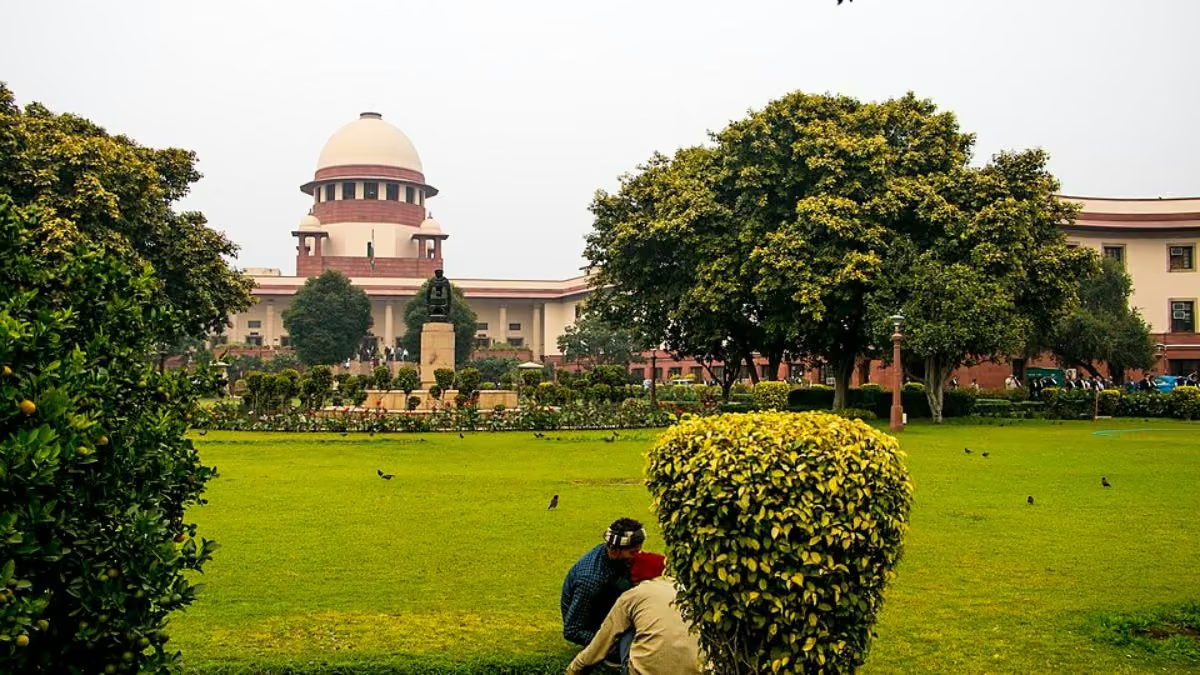
The Supreme Court of India (SC) has passed an interim order that will restrict the appointment of teachers in schools and colleges unless they meet the qualifications that have been stated under the applicable education laws.
The apex court bench, with Surya Kant, Chief Justice of India, Joymalya Bagchi and V Mohana, Justices, passed the order during a hearing of a Public Interest Litigation (PIL) that was challenging statutory schemes related to making teachers and other education staff government employees.
The bench ordered, “As an interim measure, no teacher shall be appointed/observed in schools/colleges unless possessing requisite prescribed qualification under Right to Education Act/NCTE Act/UGC Act.”
Court focuses on teacher qualifications
The interim order was announced at the initial stage of the PIL, when the Court issued notice in the matter. The PIL had challenged the constitutional validity of schemes that allow teachers and other employees of educational institutions to serve under regular government services without a proper recruitment process.
The petition had raised questions over whether such schemes can allow teachers to enter substantive government service without following the recruitment procedures for such appointments. The rules are different for different institution categories.
The plea has argued that such provincialisation schemes should not exist. The Supreme Court’s interim order has now emphasized following the prescribed qualifications, while the Supreme Court’s decision on the broader legal challenge is still pending.
The court will further consider the PIL and the responses from the concerned authorities. The interim order will remain effective until the Court issues further directions.
Impact on teacher recruitment
The NCTE regulations govern teacher education and prescribe school-teacher qualifications; the RTE framework, meanwhile, takes care of elementary education, while UGC norms only apply to higher education.
The Supreme Court’s order makes clear that schools and colleges have to follow the qualifications required under the relevant laws while appointing teachers.
Though the order is interim and not a final decision, it should be followed. The PIL proceedings might also bring changes in the way teachers are recruited and posted to government service, with transparency, accountability and proper recruitment systems.