Three more IITs to offer B.Cybersecurity, hold JEE-like exam: IIT Kanpur official
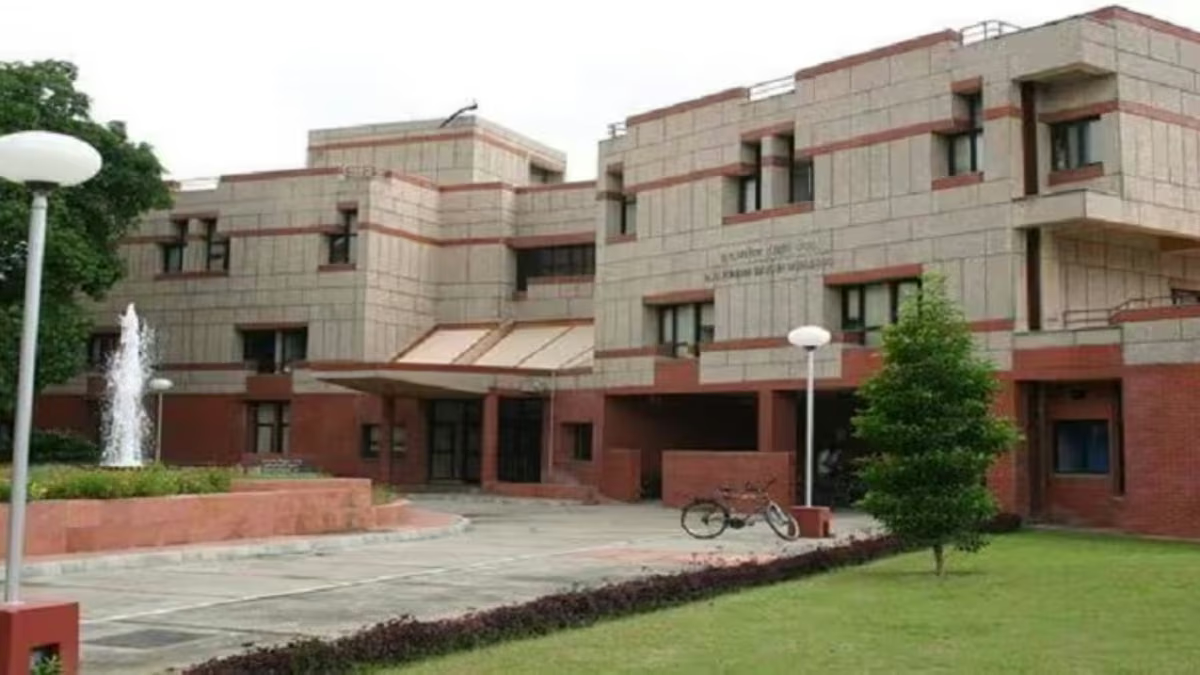
The Indian Institute of Technology Kanpur (IIT Kanpur) and the Indian Institute of Technology Madras (IIT Madras) have recently started the new Bachelor of Cybersecurity (B Cybersecurity) course with 52 students. More IITs will start offering this course.
The additional IITs will jointly conduct an entrance examination like the Joint Entrance Examination (JEE) Main and JEE Advanced. The revamped selection procedure will evaluate candidates’ ‘hacker mindset’ through their logical thinking, problem-solving ability and knowledge of basic computer science.
In an interview with reporter Sheena Sachdeva of Careers360, Somitra Sanadhya, professor at Wadhwani School of AI and Intelligent Systems and course in-charge, IIT Kanpur, said, “JEE Main and JEE Advanced test the fundamental understanding of physics, chemistry and mathematics, which is a good skill to have.”
He also added, “But for cybersecurity, we want students with a different bent of mind – what we call a “hacker's bent of mind” – or one who thinks about how to break a system. This is usually not testable through the standard tests of physics, chemistry and mathematics. That is the reason we want at least a certain level of mathematical and logical ability.”
Also Read | IIT Kanpur collaborates with UP govt, SCERT to train 900 secondary teachers in digital skills
More IITs will soon join IIT Kanpur, Madras
Future admissions will expand as three more Indian Institutes of Technology prepare to join the curriculum framework. Officials plan to implement a joint examination model distributed across multiple locations to manage candidate volume efficiently, reported Sheena Sachdeva.
The initial assessment screens thousands of applicants using objective questions on operating systems and programming. The selected candidates then go through a hackathon, which is supposed to test the practical abilities and problem-solving skills in real-life scenarios.
The newly introduced bachelor programme B.Cybersecurity will evaluate the candidates through a two-stage process. This selection process consists of a theoretical test on math, logical reasoning and basic computer science, and a practical hackathon event where candidates solve live security puzzles.
Also Read | BITS Pilani, IIT Madras sign agreement to boost academic collaboration via student exchange, joint research
2+2 curriculum model
The academic structure is based on 2+2, with half the duration on campus and the other half on practical internships. Students begin the program by learning about cryptography and malware analysis before moving on to government organisations.
Modern digital threats are addressed by artificial intelligence tools and large language models integrated into classroom learning. This practical approach enables learners to develop tangible defence mechanisms for advanced network attacks.
This 2+2 curriculum combines theoretical fundamentals with real-world field experience to prepare graduates to be uniquely qualified to secure critical infrastructure. As these future cyber defenders enter the workforce, they are prepared to keep up with evolving threats and protect our digital society.