Francis Halzen wins Nobel Prize in Physics 2026 for IceCube observatory, neutrino discovery
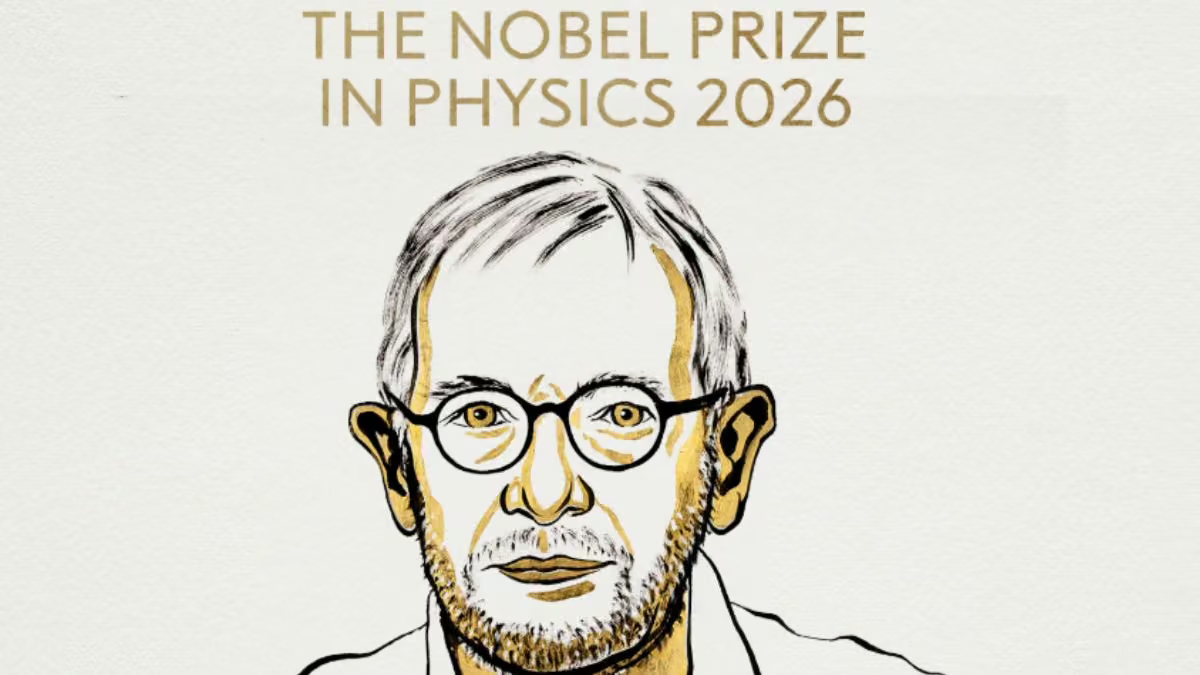
The Royal Swedish Academy of Sciences has announced the Nobel Prize in Physics 2026. Francis Halzen has been honoured for his research work on detecting high-energy neutrinos from distant parts of space. The academy has recognised his vision in developing the IceCube Neutrino Observatory at the South Pole.
In 1988, Halzen first proposed that the ice at the South Pole could be used to find neutrinos. His idea then started the development of IceCube, which is a huge observatory built in Antarctic ice, with thousands of sensors that detect light.
In an X post following today’s prize announcement, Francis Halzen said, “I hope this reflects on the really courageous people who joined me in the beginning of this project when no respectable conservative physicists would have joined me, but many talented people did, and that’s why I’m here.”
Halzen was born in 1944 in Tienen, Belgium and he completed his Doctor of Philosophy (PhD) at KU Leuven in 1969. He is currently a professor at the University of Wisconsin-Madison in the United States.
Also Read | IIT Madras prof Thalappil Pradeep becomes the third Indian to be elected to European Academy of Engineering
Francis Halzen study: How IceCube detects neutrinos
Neutrinos are tiny particles that are found in the universe. They can pass through matter, including the Earth and the human body, with very little interaction. This makes them very difficult to detect.
On a very rare occasion, a neutrino collides with an atomic nucleus. When this happens inside the Antarctic ice, the interaction makes a small flash of light. IceCube uses the light sensors deep in the ice to find out about these flashes and track the neutrinos.
The South Pole is suited for this type of observatory. The deep ice is clear for the sensors to detect the light produced when neutrinos interact with matter. Since the location is remote, it reduces interference, and the area is also geologically stable. The IceCube Neutrino Observatory was completed in 2011 and it includes nearly about one cubic kilometre.
Also Read | IIT Guwahati researchers develop affordable technology to remove arsenic and fluoride from groundwater
IceCube opens a new way to study the universe
Scientists have long known that some objects in space can create particles with higher energy than those produced by particle accelerators on Earth. However, many of these cosmic objects are not well understood yet.
The Nobel Committee said Halzen’s work has helped to establish a new form of astronomy based on neutrinos. Continued observations from IceCube might help scientists to understand the powerful conditions in space that make high-energy neutrinos. These observations may help in the discovery of new things in the universe.