IIT Delhi researchers develop India’s first working micro-GPU for local graphics systems
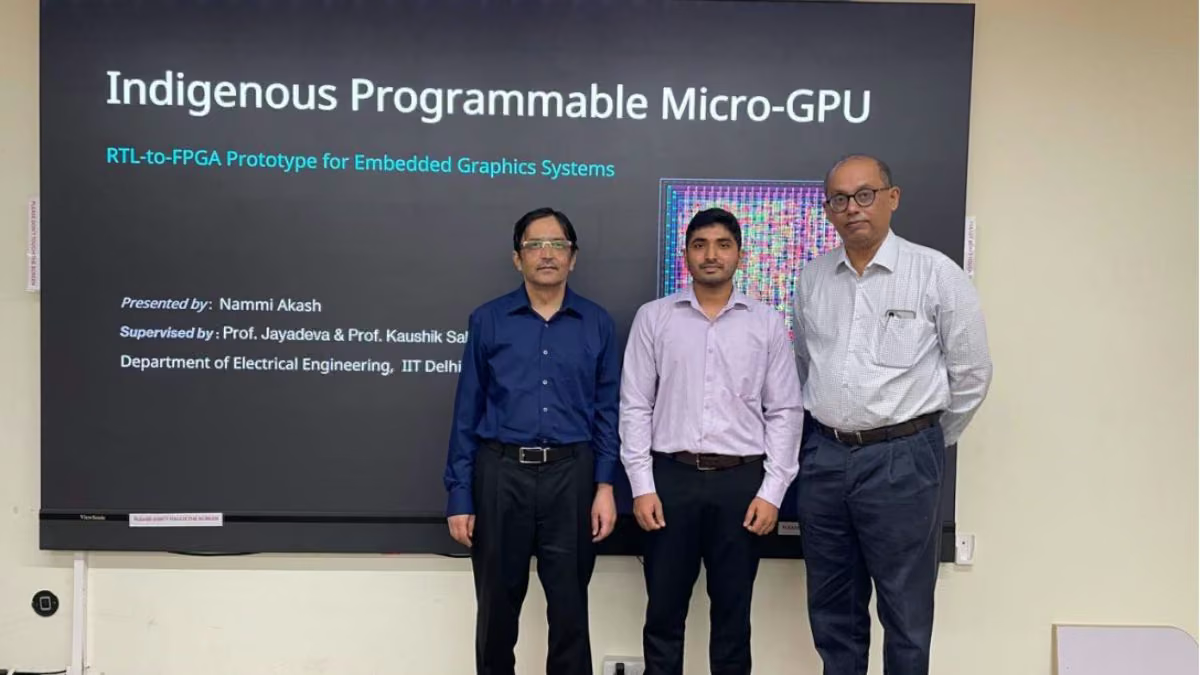
The Indian Institute of Technology Delhi (IIT Delhi) researchers have developed India’s first working, demonstrable micro-Graphics Processing Unit (micro-GPU). The researchers described the development as something that could help reduce the need for imported GPUs.
The new micro-GPU will also support the development of graphics and display systems which are made in India. According to the IIT Delhi researchers, the new micro-GPU is developed for embedded systems which require affordable and efficient graphics processing.
In a joint statement, Nammi Akash and Ravi Teja, Master of Technology (M Tech) students, said, “Our objective was to create a compact but genuinely programmable graphics-processing architecture suitable for FPGA implementation and future ASIC realization. We hope such indigenous hardware systems can support affordable digital-access platforms and contribute meaningfully toward bridging the digital divide.”
IIT Delhi micro-GPU: Applications, plans
The researchers said the hardware architecture developed will be used as a programmable graphics processor for many embedded applications. This architecture is for small fishing boats, educational e-book readers which include industrial control displays, low-cost human-machine interfaces, e-rickshaw dashboard navigation systems, and inland-water navigation terminals.
The design can be implemented on FPGA-based systems and could also be converted into an Application-Specific Integrated Circuit (ASIC). Application-Specific Integrated Circuit is a chip designed for a specific application.
The research team will now be working on a roadmap for an Rs 8 to Rs 16 core vector-style graphics processor, along with a compiler and graphics software tools. It will also help in exploring a proof-of-concept implementation which will use a 65-nanometre ASIC process.
Professor Jayadeva said the project shows how well indigenous programmable graphics hardware will be shared for affordable computing systems. Another professor, Kaushik Saha, said the project will give students some kind of experience in hardware design, programmable architectures, compilers and embedded systems.
The researchers said they also plan to ask for funding for ASIC development, system integration and, in the future, making the technology into a product or system that can be developed, manufactured and sold commercially.