IIT Guwahati develops sustainable technology to treat polluted wastewater from pig farms
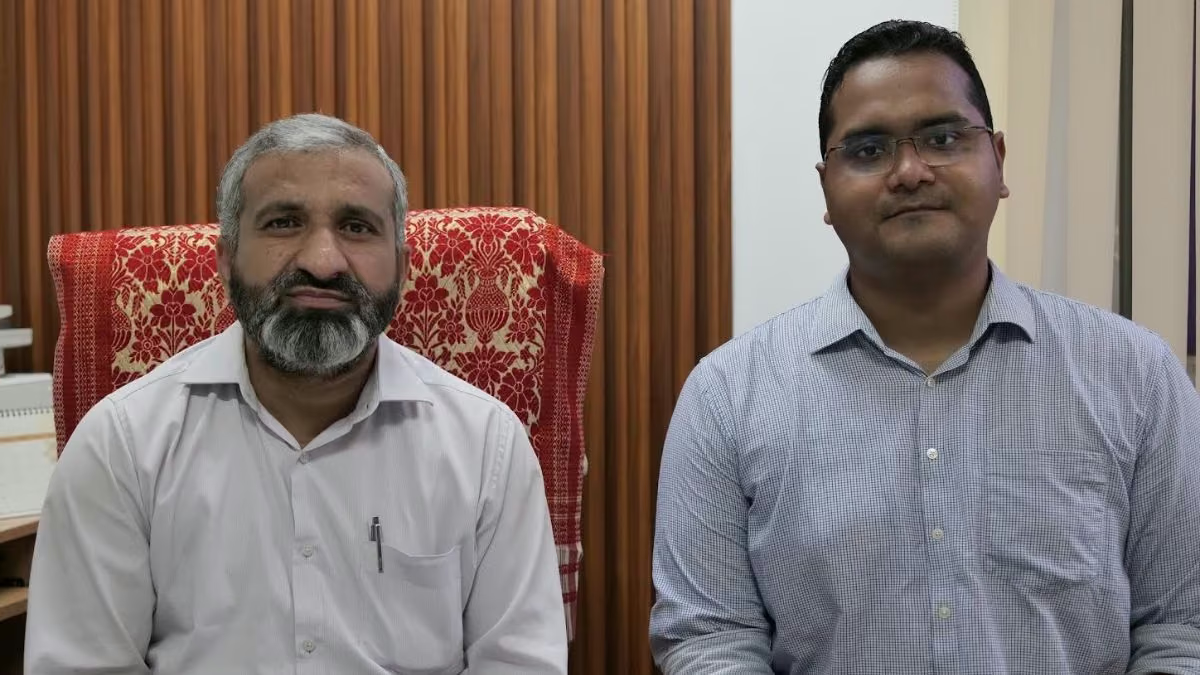
Researchers at the Indian Institute of Technology (IIT) Guwahati have developed a compact, low-energy system that treats highly polluted wastewater from pig farms. The research was conducted by the Waste Management Research Group in the Department of Civil Engineering at IIT Guwahati.
As part of a research and development collaboration with IIT Guwahati, the researchers tested the system using swine wastewater, which was collected from the ICAR-National Research Centre on Pig (ICAR-NRCP), Assam.
Highlighting the special features of the study, Ajay S Kalamdhad, Department of Civil Engineering, IIT Guwahati said, “Our Research Team not only wanted to reduce pollution indicators but also to make wastewater biologically safer for the environment. We have demonstrated a compact and energy-efficient solution that could be adapted for decentralised livestock farms by engineering the movement of wastewater and combining it with the natural treatment abilities of plants and microorganisms.”
Also Read | Education Ministry opens recruitment for IIT Mandi director position
IIT Guwahati system reduces pollutants, harmful microbes
Researchers at IIT Guwahati used an onion-based test to check the harmful effects of the treated water and found that its toxicity and harmful bacteria were reduced. The researchers said the system could be used for other rural and agricultural wastewater treatment needs.
The research findings were published in the Journal of Environmental Management. The paper was co-authored by Monish Goswami, Sandip Ghosh and Ajay S Kalamdhad, all professors of IIT Guwahati.
Speaking about the unique aspects of this research, Monish Goswami, PhD Scholar, IIT Guwahati, added, “Unlike conventional constructed wetlands where wastewater flows directly through the treatment bed, our system incorporates ‘internal baffles’ (built-in partitions) that force wastewater to travel along a longer zig-zag pathway and undergo aerobic-anoxic transitions.”
He also added that the design will allow wastewater to stay longer with plant roots, helpful microorganisms and gravel, which will improve the treatment process. The research team will test the technology and develop a low-cost, sustainable wastewater treatment solution for livestock farms across India.