IIT Madras international study finds air pollution could improve urban flood forecasting
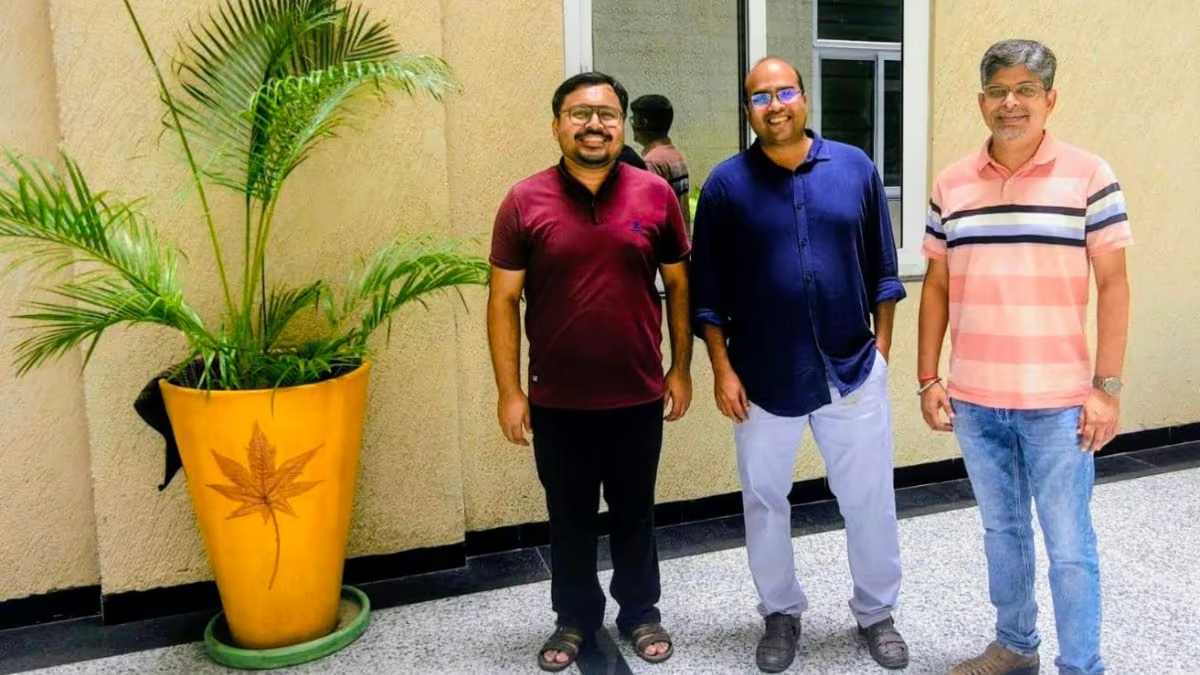
The Indian Institute of Technology Madras (IIT) Madras has conducted an international study. The study found that air pollution levels could affect rainfall and forecasts which are related to urban flooding. Researchers from fields like atmospheric science, hydrology, flood modelling and Earth observation have worked together.
The research was led by scientists from IIT Madras, GFZ Helmholtz Centre for Geosciences, Germany, the Japan Aerospace Exploration Agency (JAXA) and Kathmandu University, Nepal. The researchers used Chennai’s extreme rainfall and flooding in December 2015 as a case study.
Explaining the importance of the research, Chandan Sarangi, Department of Civil Engineering, IIT Madras, and corresponding author, said, “Urban flood forecasting is often treated primarily as a rainfall-to-runoff problem. The problem in urban flood forecasting is that rainfall spatial and timely distribution is not well captured by our weather models.”
Also Read | Education Ministry opens recruitment for director, VC positions at IITs, IISERs
IIT Madras study on role of air pollution in flood forecasting
The study also finds that using atmospheric conditions are important for flood modelling instead of seeing at rainfall alone. Better rainfall estimates can help in improving predictions related to runoff, reservoir inflows and the amount of urban flooding.
The findings were published in Natural Hazards and Earth System Sciences. This is a peer-reviewed international journal which covers research on natural hazards along with their impact on society and the environment.
S N Kuiry, Department of Civil Engineering, IIT Madras, added, “For a megacity like Chennai, rainfall forecasting cannot be considered in isolation from water-resources management. Timing and spatial distribution of extreme rainfall directly influence runoff, reservoir inflows and flood forecasting. A coupled atmosphere–hydrology–hydraulic framework can provide a more physically informed basis for these interconnected decisions.”
The IIT researchers said the approach can also be studied in other cities that have or are currently facing heavy rainfall and flooding, especially in areas that are experiencing rapid urban growth and have limited capacity to store excess water.