IIT Madras unveils 3D Stroke Atlas, plans to map 100+ human brains
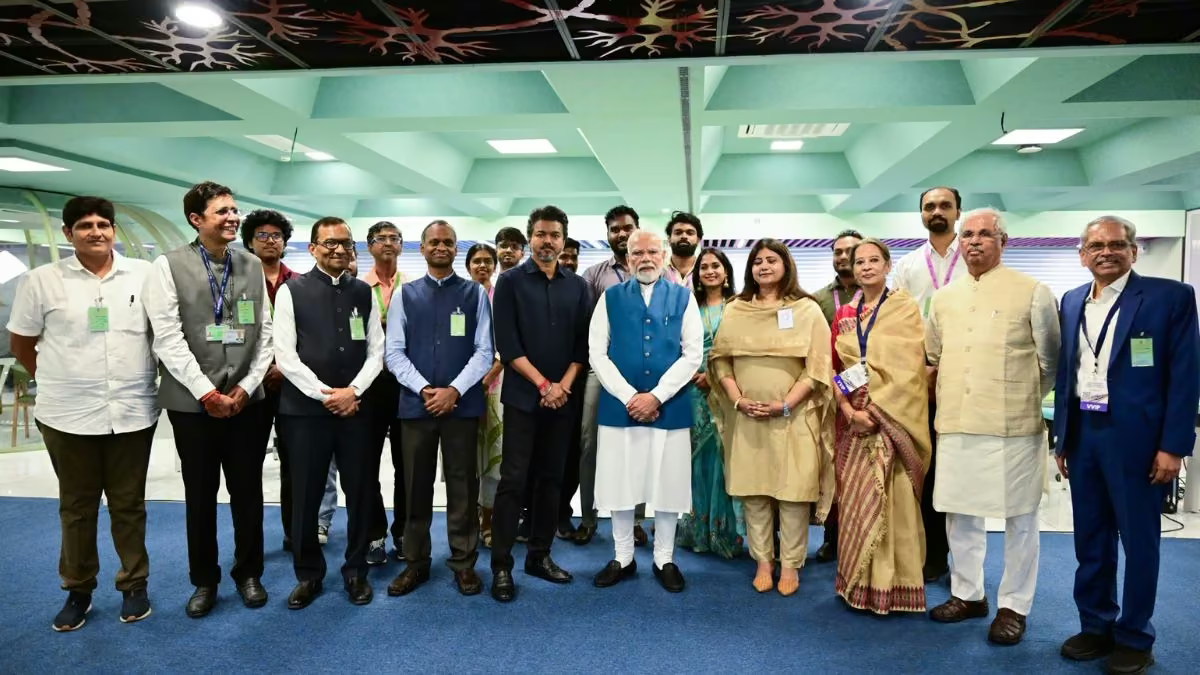
Sudha Gopalakrishnan Brain Centre at the Indian Institute of Technology Madras has initiated a global mission to map more than 100 human brains into 3D digital atlases at cell-resolution across the human lifespan.
Prime Minister Narendra Modi on Sunday launched the project at the Indian Institute of Technology (IIT) Madras, dedicating the centre to the nation and releasing C-STROKE, recognised as the world’s first human ischemic stroke atlas developed at the facility.
Spanning human lifespan stages from fetus to old age and covering brain-related conditions, the initiative represents the largest collection of cell-resolution 3D whole human brain digital maps created to date.
Also read | BITSoM-EFMD survey: 73% of B-school leaders expect AI to reshape management education
High-resolution brain mapping
The centre utilises its brain imaging and computing platform to process whole post-mortem human brains into high-throughput digital 3D maps. These open-access atlases are distributed via a multi-modal image visualisation framework, enabling researchers, medical professionals, and patients globally to utilise the findings.
The international mission involves more than 200 researchers, engineers and technicians at SGBC, more than 10 domestic medical institutions and more than 30 international researchers from 10 countries. C-STROKE, which is supported by Prem Watsa, chairman of Fairfax Financial, an alumnus of IIT Madras, uses millimeter-scale pre-mortem MRI scans with micron-resolution whole-brain histology.
Also read | 3,898 Indian scientists among the ‘World’s Top 2%’ list
Cellular insights and computing
This atlas, with over 1,000 annotated sections of a stroke-affected brain, explains the clinical imaging signatures at a microscopic level, describing important cellular markers including neuronal health, neuroinflammation, blood-brain barrier disruption, hypoxia, and axonal injury.
The Param Shakti supercomputer funded by the Ministry of Electronics and Information Technology (MeitY) generated the 3D maps. In order to analyze cerebrovascular pathology across spatial scales and identify new treatment targets directly in the human brain, the platform offers an open-access data viewer and analysis suite.
IIT Madras alumnus and key donor to the centre, Kris Gopalakrishnan, co-founder of Infosys, said: “The visit of Honourable Prime Minister is a great inspiration for the scientists working on this mission. I hope this will also inspire philanthropists to support this world-class research in India which needs to scaled up”.
Mohanasankar Sivaprakasam, head of SGBC at IIT Madras, said: “It is our utmost privilege to have our PM kicking off this mission that combines brain sciences, engineering, medicine and technology. We envision that these maps and atlases will have significant implications for neurosciences and neuromedicine for decades to come.”
Established in 1959, IIT Madras holds the top rank in the 'Overall' category for seven consecutive years (2019–2025) and in the 'Engineering Institutions' category for 10 consecutive years (2016–2025) under the National Institutional Ranking Framework.