Nobel Prize 2026: Three Optogenetics Pioneers Win Medicine Award
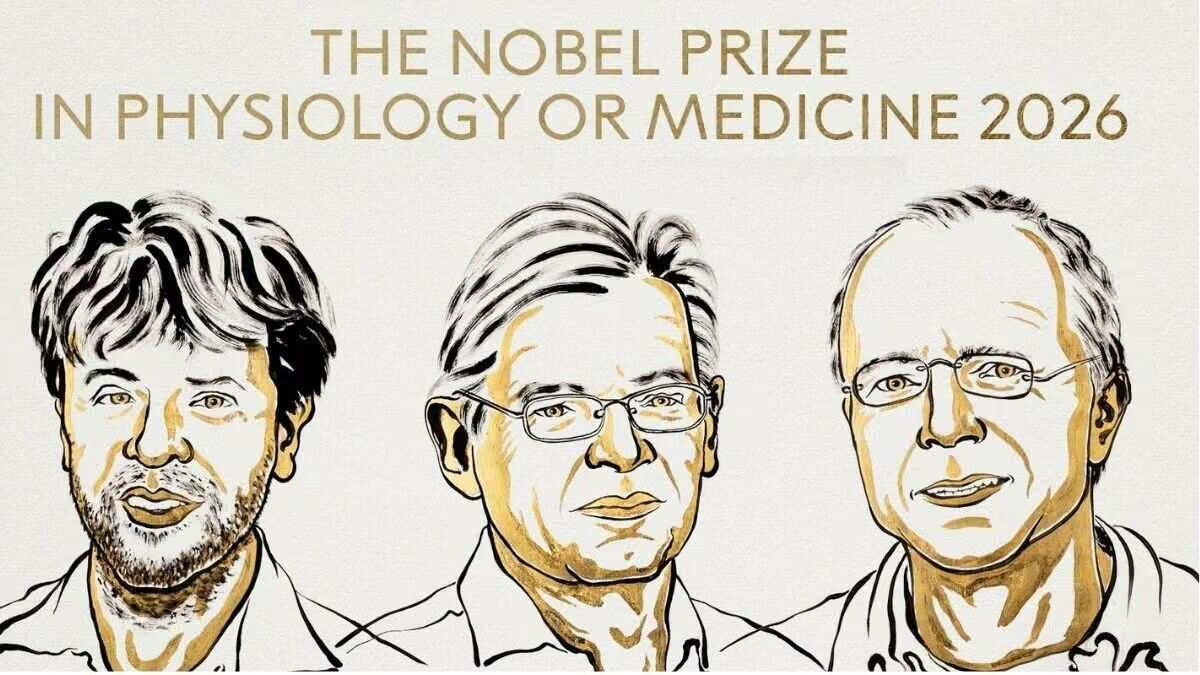
Three scientists have jointly won the Nobel Prize 2026 in physiology or medicine for discoveries that allowed researchers to control brain cells with light. The Nobel Assembly at Karolinska Institutet, Stockholm, has today announced Karl Deisseroth, Peter Hegemann and Georg Nagel as joint laureates “for their discoveries concerning light-gated ion channels and optogenetics’.
Optogenetics is a revolutionary approach that uses light-sensitive proteins to switch individual nerve cells on and off. This light-controlled switch is revolutionising the way scientists map brain circuits, investigate human behaviour and explore treatments for neurological disorders.
Peter Hegemann received his Ph.D. from the Max-Planck-Institute for Biochemistry in Martinsried, Germany. Karl Deisseroth is the D.H. Chen Professor of bioengineering and of psychiatry and behavioural sciences at Stanford University. Georg Nagel received his Ph.D. from the University of Frankfurt, Germany, is a professor of molecular plant physiology at the Department for Molecular Plant Physiology and Biophysics - Botany, University of Wuerzburg, Germany.
Also read | Francis Halzen wins Nobel Prize in Physics 2026 for IceCube observatory, neutrino discovery
Algae study sparked discovery
The research began when Hegemann investigated how a single-celled species of green algae moves toward light sources. While working together, Hegemann and Nagel identified a protein acting as an ion channel, opening to trigger an electrical impulse whenever exposed to blue light. By inserting this protein into other cells, they demonstrated that non-light-sestitive cells could be made responsive to illumination.
Deisseroth subsequently engineered the gene controlling the protein into brain cells, creating a functional light switch within the brains of living mice. His work made it possible to target specific neural pathways without distributing surrounding tissue.
Speaking to the Associated Press shortly after receiving the call from Sweden, Deisseroth described himself as a night owl who was awake working when the news arrived. He added that his immediate priority before celebration was packing school lunches for his sleeping children.
Nobel Prize 2026: starts with medicine
The medicine award is the first of the traditional Nobel announcements, with physics, chemistry, literature, peace and economic sciences to be announced in the coming days. The 2026 Nobel Prize comprises a total of 12 million Swedish kronor in the form of a cash award, split equally between the three laureates, each of whom receives one third.
Last year, the medicine prize went to three researchers studying the human immune system. According to NobelPrize.org, the official portal of the awards, the prize money remains fixed at 12 million Swedish kronor whether awarded to an individual, a small team, or an entire organisation.