Henri Kagan, Kenso Soai win Nobel Prize in Chemistry 2026 for their discoveries in chemical asymmetry
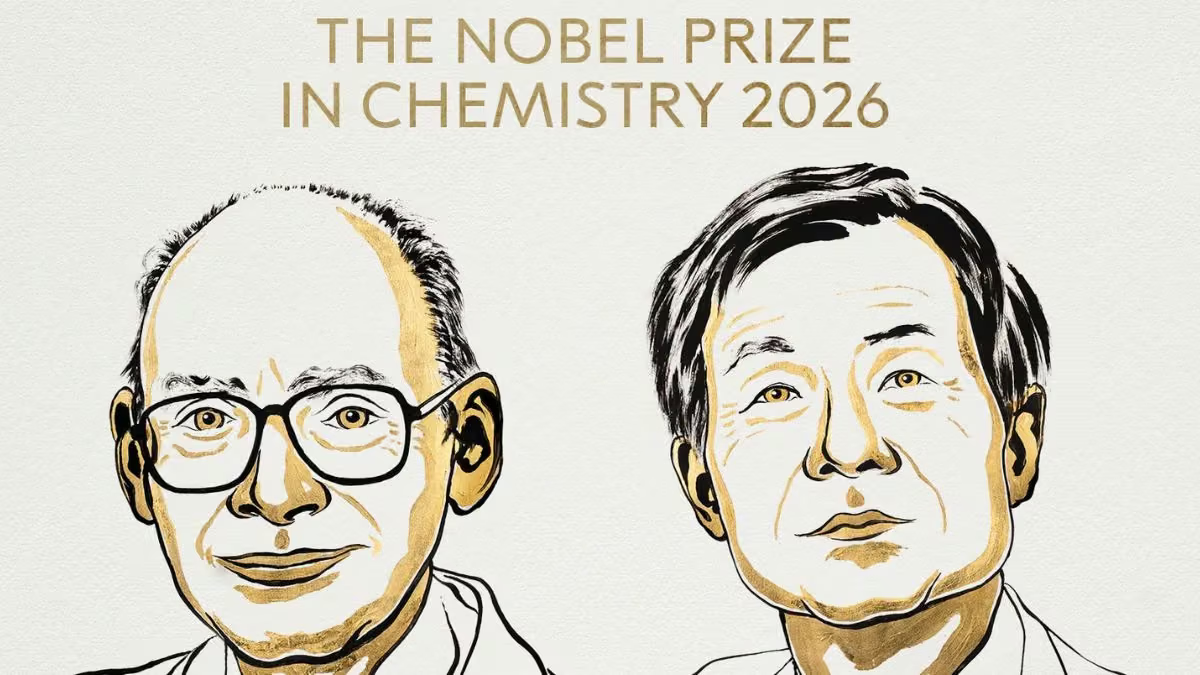
French chemist Henri B Kagan and Japanese chemist Kenso Soai have been awarded the 2026 Nobel Prize in Chemistry for their discoveries, which explain how chemical reactions can produce molecules.
In a recent post on X, The Royal Swedish Academy of Sciences announced that, “It has decided to award the 2026 #NobelPrize in Chemistry to Henri B. Kagan and Kenso Soai for the discovery of non-linear effects and autocatalysis in asymmetric organic synthesis.”
The two laureates will share the 12 million Swedish kronor prize equally. Kagan and Soai have shown how a chemical reaction can be controlled to produce a mirror-image form of a molecule instead of producing both forms in the same proportion.
Also Read | Francis Halzen wins Nobel Prize in Physics 2026 for IceCube observatory, neutrino discovery
Henri Kagan made the first breakthrough
In 1986, Henri Kagan made an important discovery that helped scientists understand how to start solving the problem. He later discovered a new way to control chemical reactions that allowed one mirror-image molecule to be produced in larger amounts than the other.
In 1995, Kenso Soai built on this work and he reported a chemical reaction with the potential to produce a single mirror-image form through a process called autocatalysis. In 2003, he was successful in developing the chemical reaction that produced only one of the two possible mirror-image forms of the molecule, and not the other.
Also Read | Nobel Prize 2026: Three optogenetics pioneers win Medicine award
Discoveries could help drug development
The discoveries of Kagan and Soai have been useful for chemists who have been developing different molecules used in medicines. The Nobel Committee said both their research work in chemistry have provided easy ways to form a drug molecule.
According to another post on X, “The Soai reaction – developed by 2026 laureate Kenso Soai – has awakened new enthusiasm in chemists who want to understand the life’s origins. Around the world, researchers are now trying to repeat Soai’s achievement, but with the aim of producing homochiral amino acids and sugars.”
Born in 1930 in Boulogne-Billancourt, France, Henri Kagan is Professor Emeritus at the former Université Paris-Sud. Kenso Soai, born in 1950 in Hiroshima, Japan, is Professor Emeritus at Tokyo University of Science.